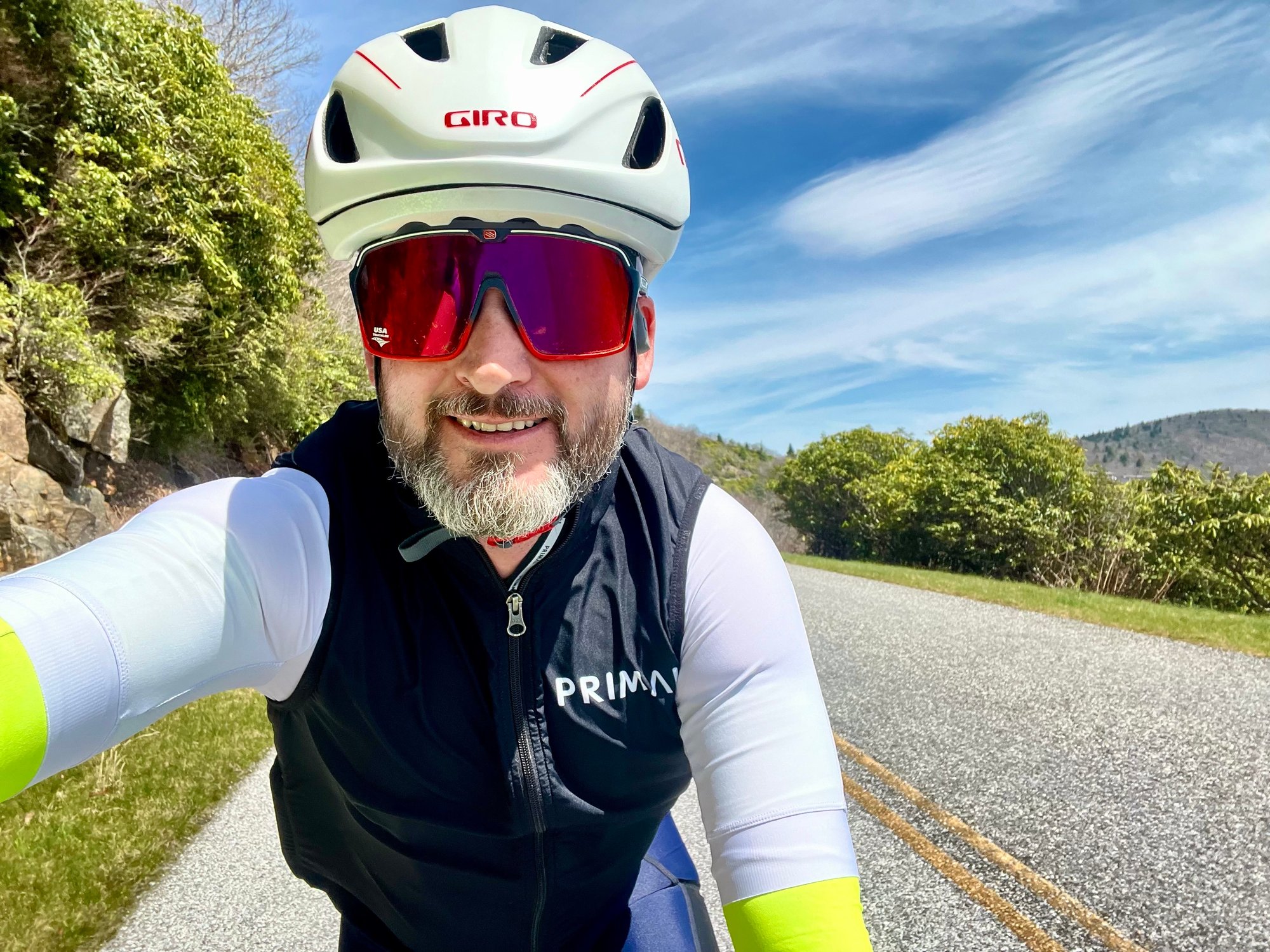
Carolina Multisports cycling in the Blue Ridge Mountains

Blue Ridge Parkway Bike Tour

History, Wildlife, and Wind in Your Hair

Discover the Blue Ridge Mountains by Bike

Join us in the spirit of camaraderie, philanthropy, and sport on an 8-day, 469-mile fully supported charity ride along the Blue Ridge Mountains of North Carolina and Virginia. The ride is self-paced and open to all abilities.

Coach Joel cycling on the Blue Ridge Parkway

A backdrop of captivating landscapes and rich cultural history

The Blue Ridge Parkway is a scenic highway that stretches for 469 miles along the spine of the greater Appalachian (pronounced, App-a-LATCH-an) mountain chain, connecting the Great Smoky Mountains National Park in North Carolina to Shenandoah National Park in Virginia. It was conceived during the Great Depression as part of the New Deal’s efforts to create jobs and stimulate the economy. Construction began in 1935, and the parkway was completed in 1987.

The parkway provides cyclists with an immersive experience as they pedal through a diverse range of ecosystems from rolling meadows to high altitude boreal forests. One of the highlights of the Blue Ridge Parkway is its numerous scenic overlooks, providing panoramic views of the surrounding mountains and valleys. These overlooks are perfect spots for participants to take a break, soak in the scenery, and capture memorable photos. Notable viewpoints include Craggy Gardens, Linville Viaduct, and Grandfather Mountain.

The Blue Ridge Parkway is intricately intertwined with the historical narrative of the Highlanders who first settled this rugged terrain. Hailing from Scottish and Irish immigrant roots, these Highlanders brought their rich cultural heritage of independence, durability, and resilience to the region, leaving an indelible mark on the landscape. This creates an unparalleled and motivational backdrop for personal development, where the spirit of the past converges with the journey of the present.

Pisgah Inn, Blue Ridge Parkway
Old Growth Fraser Fir at Mt. Mitchell on the Blue Ridge Parkway
Roadside ferns on Blue Ridge Parkway

Tunnels

The Blue Ridge Parkway features a total of 26 tunnels along its route, each contributing to the overall experience of biking through the picturesque mountain scenery. Tunnels were carefully placed and designed to blend with the environment. The architects and engineers aimed to ensure that the parkway provided a harmonious experience, allowing travelers to appreciate the scenic vistas without disruptions.

Day 1 – 106 miles

Day-1-Route-Profile-ACEXOBX.png

Click for GPS File and Cue Sheet

We’ll start in the bustling port town of Morehead City. We’ll see commerce in motion with large container ships coming and going and trains gathering their loads to distribute across the county. We’ll quickly head out into the countryside with marshland flanking the road. Migrating birds will be plentiful and keep your eye out for the occasional alligator.

At mile 41, we’ll ride the first of two ferries, from Cedar Island to Ocracoke Island. I recommend riding into town for ice cream or coffee and then over to the Ocracoke lighthouse. After only 14 more miles on the bike, we’ll ride the second ferry over to Cape Hatteras. Once in Hatteras, be sure to take a quick detour to see the Cape Hatteras Lighthouse, the nation’s tallest lighthouse.

From there, we’ll head due north along a thin ribbon of sand with the Atlantic Ocean on our right and Pamlico Sound on our left. Along the way be sure to stop for a break and check out the historic US lifesaving service station, Little Kinnakeet, just north of Avon, or stop in at a cozy coffee shop in Rodanthe and reminisce about the romantic movie filmed there, Nights in Rodanthe.

We’ll finish the day traversing Pea Island National Wildlife Refuge. Along the way, we’ll ride across two of the longest bridges on the Outer Banks. When crossing Oregon Inlet, keep your eye out for the numerous fishing boats coming and going from the port in Wanchese, where the famed reality TV series Wicked Tuna was filmed. 

We’ll be camping for the first of two nights at the Oregon Inlet Campground.

Linn Cove Viaduct

The Linn Cove Viaduct is an engineering marvel and a notable feature of the Blue Ridge Parkway. Construction of the Linn Cove Viaduct began in 1979 and was completed in 1983. The viaduct was designed to minimize the environmental impact on Grandfather Mountain, a region known for its ecological diversity and rugged terrain. It represents the final link to complete the entire 469-mile length of the Blue Ridge Parkway.

Day 2 – 112 miles

Day-2-Route-Profile-ACEXOBX.png

Click for GPS File and Cue Sheet

We’ll explore the northern end of the Outer Banks on Day Two, including the popular towns of Nags Head, Kill Devil Hills, Kitty Hawk, Duck, and Corolla.

Immediately after leaving camp, you’ll want to take a quick detour over to the Bodie Island Lighthouse. We’ll add on a loop to include a tour of Manteo to get our 100 miles in for the day. On our way around Manteo, we’ll traverse the longest bridge in North Carolina at 5.2 miles.

After heading north again, Jockey’s Ridge State Park is always a favorite, featuring eastern America’s largest sand dunes. The soft dunes and consistent winds are what lured the Wright Brothers to North Carolina to test their gliders. The Wright Brothers’ monument is a definite photo op.

Stop in Duck for the famous Duck Donuts, and if you’re lucky, you’ll see the wild horses in Corolla.

We hit the halfway point of our Outer Bank tour in Corolla and the northernmost point of the Outer Banks before turning back south again. Most days of the year, the prevailing winds are coming from the north and going south. If we’re lucky we’ll have a tailwind for the rest of the trip.

On the way back to camp, stop at one of the many piers for some seafood!

 

Mt. Mitchell

Mount Mitchell is the highest peak east of the Mississippi River and the highest point in the Appalachian Mountains at 6,684 feet (2,037 meters) above sea level. Due to its high elevation, Mount Mitchell experiences cooler temperatures than the surrounding lower elevations. The climate is often more reminiscent of northern regions, and the summit is home to a spruce-fir forest, a habitat more commonly found in the northeastern United States and Canada.

Waterfall below the Blue Ridge Parkway along US Hwy 221
Mile Post 356 on the Blue Ridge Parkway
Blue Ridge Parkway Sign

Day 3 – 106 miles

Day-3-Route-Profile-ACEXOBX.png

Click for GPS File and Cue Sheet

Whatever you didn’t get to do or see on the 1st day, you get to do today! Maybe you want to check out the Graveyard of the Atlantic Museum or spend a little extra time exploring to town of Ocracoke. Whatever it is, don’t worry about the time. The ferry system runs until midnight. The ferry from Hatteras to Ocracoke is about 30 min. The ferry from Ocracoke to Cedar Island is about 2 hours and 15 min.